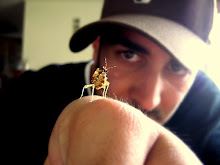
This video was a pleasure to make. This is a fiercely scaled down snippet of the awesome interview I did with Jessica in which she recounts the story of how she got to where she is--teaching kids about animals and conservation at the Oakland Zoo.
More videos will be coming soon--including a short video documentary about my Moon Bear Holiday Fundraiser Campaign (inspired by Jessica)!
Hope you all dig this one. I think it would be especially valuable to pass along to anyone you know curious about how to get started helping animals. It takes a lot of hard work, but helping animals and working towards conservation and a better, healthier Earth is some of the most rewarding sort of hard work you can do. Enjoy!
Thursday, February 26, 2009

Monday, February 23, 2009
Sunday, February 22, 2009
Jessica Klieman - Public Service Announcement
Just made another video with my friend Jessica Klieman at the Oakland Zoo! Please watch and spread the link!
Saturday, February 21, 2009
WildAid's Inspirational Campaign to Decrease Demand for Wildlife Products Drives the Message Home
It has been quite the year. So much has been happening it's hard to wrap my head around it all. Grad school classes, student teaching, completing my work for the state in order to get my credential, being a supportive husband for my wife as she continues on in her first year teaching high school, and still trying to participate and lend a hand in wildlife conservation...it has indeed been a roller coaster!
I often think, "I really should write about this in my blog today," but homework inevitably takes over. Well, I recently went to a lecture and learned of an organization about which I have to share, for which my conscience would scream at me if I didn't make every effort to spread the word about their work.
WildAid's mission: "To end the illegal wildlife trade within our lifetimes. To achieve this WildAid uniquely focuses on raising awareness to reduce the demand for threatened and endangered species products and to increase public support for wildlife conservation."
In order to do this, WildAid looked at big business that had success in the art of persuading people to buy, and used the same strategies to deliver their message to stop the buying of wildlife products. As Peter Knights, WildAid's executive director states in their showreel, "The message had to be attractive, concise, and entertaining. We needed to be as good at delivering our message as the world's best business, and we had to do it on a shoestring budget. Delivery, quality, repetition, and saturation. These are the four components that drive every successful campaign."
Their amazing success has been noted statistically in many areas of Asia. After totally bombarding Asia's population with their message (namely in China during the 2008 Beijing Olympics), delivered through video and traditional billboards, taxicab and airplane video screens, and traveling exhibits, WildAid successfully brought down the demand for shark fin soup in many areas, enough so that they were sued by a Thai company for negatively affecting their business (this actually turned out to be wonderful publicity for WildAid).
I remember being hooked to the internet and TV during the Beijing Olympics. I am an Olympics nut, and I remember seeing WildAid's adds with my favorite celebrities: Jackie Chan, Amitabh Bachan, Maurice Green, Amanda Beard, Harrison Ford, Yao Ming, Ganguly and Tendulkar from the Indian cricket team, and others. As soon as I found out more about their organization, I learned that all the star power behind WildAid's campaign was pro bono; these stars had agreed to do their part to help stop the illegal wildlife trade out of goodness of their own hearts, as had the film crews and producers who helped lend their time, equipment, and talents to make the videos.
WildAid has had an overwhelming number of successes in getting the word out. But the most important thing to remember is that you can help. About 20 of their videos are on YouTube. Please help spread the word by posting their videos wherever you can. Post them on facebook or myspace. Email them to your friends and family. Link to them on your blogs and websites. Their message is a great one, and helping them get an even wider audience takes such a small amount of time. Please take action!
Please visit their website: www.wildaid.org. You can find all their videos and a ton of information, sign a pledge, shop their store, and much more. They also have their showreel, which maps out exactly what they do and how they do it, here: http://www.wildaid.org/index.asp?CID=3
Here are a few of their videos. Enjoy!
I often think, "I really should write about this in my blog today," but homework inevitably takes over. Well, I recently went to a lecture and learned of an organization about which I have to share, for which my conscience would scream at me if I didn't make every effort to spread the word about their work.
WildAid's mission: "To end the illegal wildlife trade within our lifetimes. To achieve this WildAid uniquely focuses on raising awareness to reduce the demand for threatened and endangered species products and to increase public support for wildlife conservation."
In order to do this, WildAid looked at big business that had success in the art of persuading people to buy, and used the same strategies to deliver their message to stop the buying of wildlife products. As Peter Knights, WildAid's executive director states in their showreel, "The message had to be attractive, concise, and entertaining. We needed to be as good at delivering our message as the world's best business, and we had to do it on a shoestring budget. Delivery, quality, repetition, and saturation. These are the four components that drive every successful campaign."
Their amazing success has been noted statistically in many areas of Asia. After totally bombarding Asia's population with their message (namely in China during the 2008 Beijing Olympics), delivered through video and traditional billboards, taxicab and airplane video screens, and traveling exhibits, WildAid successfully brought down the demand for shark fin soup in many areas, enough so that they were sued by a Thai company for negatively affecting their business (this actually turned out to be wonderful publicity for WildAid).
I remember being hooked to the internet and TV during the Beijing Olympics. I am an Olympics nut, and I remember seeing WildAid's adds with my favorite celebrities: Jackie Chan, Amitabh Bachan, Maurice Green, Amanda Beard, Harrison Ford, Yao Ming, Ganguly and Tendulkar from the Indian cricket team, and others. As soon as I found out more about their organization, I learned that all the star power behind WildAid's campaign was pro bono; these stars had agreed to do their part to help stop the illegal wildlife trade out of goodness of their own hearts, as had the film crews and producers who helped lend their time, equipment, and talents to make the videos.
WildAid has had an overwhelming number of successes in getting the word out. But the most important thing to remember is that you can help. About 20 of their videos are on YouTube. Please help spread the word by posting their videos wherever you can. Post them on facebook or myspace. Email them to your friends and family. Link to them on your blogs and websites. Their message is a great one, and helping them get an even wider audience takes such a small amount of time. Please take action!
Please visit their website: www.wildaid.org. You can find all their videos and a ton of information, sign a pledge, shop their store, and much more. They also have their showreel, which maps out exactly what they do and how they do it, here: http://www.wildaid.org/index.asp?CID=3
Here are a few of their videos. Enjoy!
Thursday, January 29, 2009
Interior Crocodile Alligator
I really don't know what to say about this except that the montage is awesome... Freshwater crocodiles never looked so cool. :D
Friday, January 23, 2009
Severe Budget Cuts Proposed to the WCS
Governor David Paterson of New York recently offered one solution to help with the slumping economy: to cut funding for the Bronx Zoo and the New York Aquarium, both managed by the Wildlife Conservation Society, by 55% this year and totally eliminating support by 2010.
http://www.wcs.org/
Needless to say, this is a disastrous blow to an organization that got its start in 1895, and since then has contributed to major successes in the conservation of various species. The WCS not only manages one of the most reputable zoos in the country, but also leads conservation projects around the world and provides funding for other hard-working organizations (such as the Virunga National Park Rangers protecting mountain gorillas in the Democratic Republic of Congo).
http://www.wcs.org/
These proposed budget cuts will be devastating to the animals, to the employees, to the education of the public in regards to the environment and wildlife issues, to scientific research, and to the future of many conservation projects. In a time when the world is in more need of aid and care than ever before, this is one of the worst things that could happen to an organization that supports the cause.
http://www.wcs.org/
Please visit the WCS's website, and click on the links to find out more, and find out what petitions you can sign. Write a letter to Gov. Paterson. It shouldn't take you more than ten minutes. Show that not just New Yorkers but Americans from every state care about the survival of the WCS and the animals under their care.
http://www.wcs.org/
http://www.wcs.org/
Needless to say, this is a disastrous blow to an organization that got its start in 1895, and since then has contributed to major successes in the conservation of various species. The WCS not only manages one of the most reputable zoos in the country, but also leads conservation projects around the world and provides funding for other hard-working organizations (such as the Virunga National Park Rangers protecting mountain gorillas in the Democratic Republic of Congo).
http://www.wcs.org/
These proposed budget cuts will be devastating to the animals, to the employees, to the education of the public in regards to the environment and wildlife issues, to scientific research, and to the future of many conservation projects. In a time when the world is in more need of aid and care than ever before, this is one of the worst things that could happen to an organization that supports the cause.
http://www.wcs.org/
Please visit the WCS's website, and click on the links to find out more, and find out what petitions you can sign. Write a letter to Gov. Paterson. It shouldn't take you more than ten minutes. Show that not just New Yorkers but Americans from every state care about the survival of the WCS and the animals under their care.
http://www.wcs.org/
Monday, January 19, 2009
New Species Found off the Coast of Australia!
I'm copy and pasting this article from www.yahoo.com. I get so stoked whenever new species are found; it reminds us exactly how much about our planet we still don't know and reminds us to tread lightly! Please read!
Scientists find new creatures of Australian deep

SYDNEY (AFP) – Scientists said Sunday they had uncovered new marine animals in their search of previously unexplored Australian waters, along with a bizarre carnivorous sea squirt and ocean-dwelling spiders.
A joint US-Australian team spent a month in deep waters off the coast of the southern island of Tasmania to "search for life deeper than any previous voyage in Australian waters," lead researcher Ron Thresher said.
What they found were not only species new to science -- including previously undescribed soft corals -- but fresh indications of global warming's threat to the country's unique marine life.
"Our sampling documented the deepest known Australian fauna, including a bizarre carnivorous sea squirt, sea spiders and giant sponges, and previously unknown marine communities dominated by gooseneck barnacles and millions of round, purple-spotted sea anemones," Thresher said.
Using a submersible car-sized robot named Jason, the team explored a rift in the earth's crust known as the Tasman Fracture Zone, a sheer two kilometre (1.24 mile) drop to 4,000 metres (13,200 feet) below the ocean's surface.
Blogging on board the ship, researcher Adam Subhas said the team witnessed some "cool biology" as they descended the fracture, including the sea squirt, which he described as "basically an underwater Venus fly trap, but much bigger."
The sea squirt, also known as an ascidian, stands 50 centimetres tall on the sea floor at a depth of just over 4,000 metres. It traps prey in its funnel-like front section if they touch it when they swim past.
"The geology was fascinating too -- the sediment was incredibly fine and lightly packed; it made me think of powder snow," Subhas wrote.
Fossil coral fields were found, dating back more than 10,000 years. Thresher said samples taken would provide ancient climate data for use in global warming projections.
"Modern-day deep-water coral reefs were also found, however, there is strong evidence that this reef system is dying, with most reef-forming coral deeper than 1,300 metres newly dead," he said.
Though close analysis of samples was still required, Thresher said modelling suggested ocean acidification could be responsible.
"If our analysis identifies this phenomenon as the cause of the reef system's demise, then the impact we are seeing now below 1,300 metres might extend to the shallower portions of the deep-reefs over the next 50 years, threatening this entire community," he said.
Rising sea temperatures are blamed on global warming caused by the build-up in the atmosphere of greenhouse gases such as carbon dioxide -- which is also blamed for higher acidity in sea water.
A UN report warned in 2007 that Australia's Great Barrier Reef, described as the world's largest living organism, could be killed by climate change within decades.
The World Heritage site and major tourist attraction, stretching over more than 345,000 square kilometres (133,000 square miles) off Australia's east coast, could become "functionally extinct", the report said.
Scientists find new creatures of Australian deep

SYDNEY (AFP) – Scientists said Sunday they had uncovered new marine animals in their search of previously unexplored Australian waters, along with a bizarre carnivorous sea squirt and ocean-dwelling spiders.
A joint US-Australian team spent a month in deep waters off the coast of the southern island of Tasmania to "search for life deeper than any previous voyage in Australian waters," lead researcher Ron Thresher said.
What they found were not only species new to science -- including previously undescribed soft corals -- but fresh indications of global warming's threat to the country's unique marine life.
"Our sampling documented the deepest known Australian fauna, including a bizarre carnivorous sea squirt, sea spiders and giant sponges, and previously unknown marine communities dominated by gooseneck barnacles and millions of round, purple-spotted sea anemones," Thresher said.
Using a submersible car-sized robot named Jason, the team explored a rift in the earth's crust known as the Tasman Fracture Zone, a sheer two kilometre (1.24 mile) drop to 4,000 metres (13,200 feet) below the ocean's surface.
Blogging on board the ship, researcher Adam Subhas said the team witnessed some "cool biology" as they descended the fracture, including the sea squirt, which he described as "basically an underwater Venus fly trap, but much bigger."
The sea squirt, also known as an ascidian, stands 50 centimetres tall on the sea floor at a depth of just over 4,000 metres. It traps prey in its funnel-like front section if they touch it when they swim past.
"The geology was fascinating too -- the sediment was incredibly fine and lightly packed; it made me think of powder snow," Subhas wrote.
Fossil coral fields were found, dating back more than 10,000 years. Thresher said samples taken would provide ancient climate data for use in global warming projections.
"Modern-day deep-water coral reefs were also found, however, there is strong evidence that this reef system is dying, with most reef-forming coral deeper than 1,300 metres newly dead," he said.
Though close analysis of samples was still required, Thresher said modelling suggested ocean acidification could be responsible.
"If our analysis identifies this phenomenon as the cause of the reef system's demise, then the impact we are seeing now below 1,300 metres might extend to the shallower portions of the deep-reefs over the next 50 years, threatening this entire community," he said.
Rising sea temperatures are blamed on global warming caused by the build-up in the atmosphere of greenhouse gases such as carbon dioxide -- which is also blamed for higher acidity in sea water.
A UN report warned in 2007 that Australia's Great Barrier Reef, described as the world's largest living organism, could be killed by climate change within decades.
The World Heritage site and major tourist attraction, stretching over more than 345,000 square kilometres (133,000 square miles) off Australia's east coast, could become "functionally extinct", the report said.
Subscribe to:
Posts (Atom)